NeolemonNeolemonvsDzine AIDzine AI

One tool for everything, or one tool for your story.

Dzine is a broad all-in-one image and video studio with a consistency feature inside it. Neolemon is built for the one job that breaks a children's book: keeping the same cartoon character recognizable on every page.

20 free credits. No card required.

4.5
Trustpilot, 94% 5-star
1M+
uses on our GPT
60%
publish to KDP
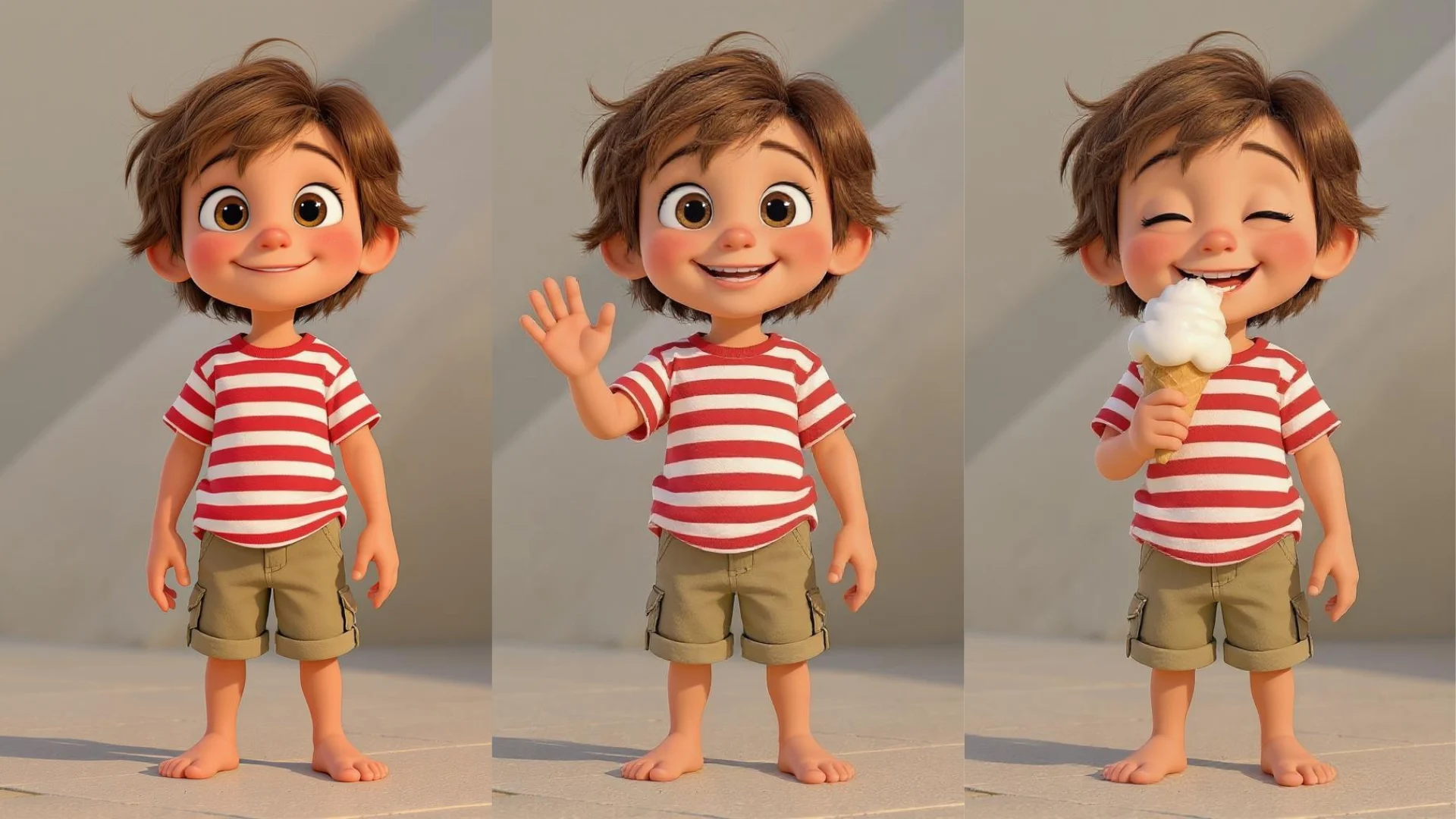
The same cartoon boy in three poses with an identical face, hair, and outfit

One character. Three poses. Zero drift.

The 90-second verdict

Who each one is for.

You're probably on Dzine now, or weighing it. Here's the honest split before any of the detail. We're not going to pretend Dzine is weak, because it isn't.

Choose Dzine AI

You want one subscription for many jobs: image generation across many models, AI video, lip sync, face swap, virtual try-on, product shots, and broad design editing. It's a genuine all-in-one studio.

Choose Neolemon

Your job is a story: a children's book, comic, classroom series, or coloring book where one cartoon character has to survive every page, pose, and expression.

Use both

Illustrate the book in Neolemon, then make the launch trailer or talking-character clip in Dzine. Different jobs, different tools.

The one-line truth: Dzine is broader, Neolemon is narrower. Buy the one that matches the job you're actually trying to finish.

The whole comparison in one line

Dzine is a toolbox. Neolemon is a workflow.

Dzine puts dozens of models and tools in one workspace and lets you assemble whatever you need. Neolemon takes one hard problem, character consistency across a story, and builds the entire product around solving it. That single choice is the whole comparison.

Dzine's own guide tells you to "keep character descriptions consistent and avoid unnecessary details" when you generate more images.
That's good advice, and it's the tell: in Dzine, holding the character steady is still your job to manage. In Neolemon, it's the product's job.

What you're comparing

Two tools, two jobs.

Most "Dzine AI alternative" pages are sloppy here, and most are out of date. Dzine moves fast. Here is precisely what each one is, as of 2026.

Dzine AI

Dzine AI

An all-in-one image and video studio

Operated by Seekoo LLC, founded 2023, built by founders out of Adobe Research, Tencent AI Lab, and ByteDance. It used to be called Stylar AI. It raised a Series A reported at more than $10M in 2026. This is a credible, well-funded product, not a thin wrapper.

  • Image generation across many models. Nano Banana Pro, Midjourney, GPT Image, Seedream, and Flux, all from one workspace.
  • AI video and lip sync. Veo, Sora, Kling, and Wan, plus single and multi-character lip sync, talking avatars, and TikTok-style clips.
  • A real consistent-character system. Train a character from up to 30 photos, store it, and reuse it with preset actions and reference sheets.
  • Broad editing. Chat-style edits, a drag-and-drop canvas with layers, face swap, virtual try-on, image-to-3D, and product photography.
Neolemon

Neolemon

A cartoon-story character workshop

Formerly ConsistentCharacter.ai. Bootstrapped by two founders in Faro, Portugal, with one filter on every feature: does this help a storyteller bring a cartoon character to life? Cartoon-only since 2025, on purpose.

  • Character Turbo builds one anchor character from structured fields. 4 credits an image.
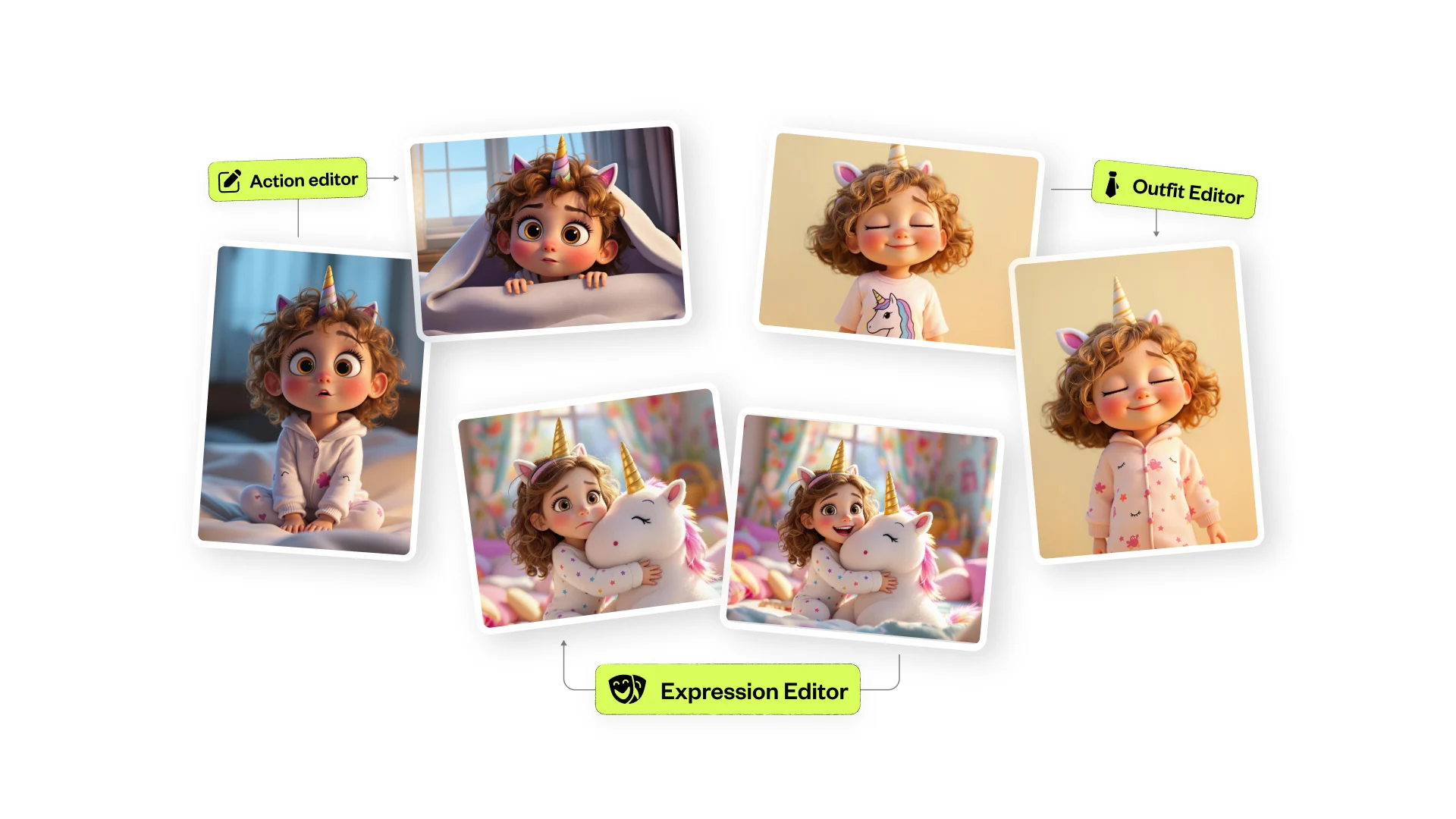
  • Action, Expression, Outfit, Perspective editors change one thing at a time with identity locked.
  • Multi Character and Story Scene Pro compose one to three characters with a background reference.
  • AI Canvas, Coloring Book Creator, Storyboard take you from loose assets to a laid-out book.
Neolemon editors generating the same character in different poses and outfits

Surface area is the difference

Breadth is Dzine's strength, and its tax.

The same thing that makes Dzine powerful for a marketer makes it heavy for an author. Here's the surface each one asks you to learn.

Dzine asks you to choose

the toolbox
Text to image Image to image Nano Banana Pro Midjourney GPT Image Flux Veo Sora Kling Lip sync Face swap Virtual try-on Image to 3D Product background Talking avatar AI podcast Consistent character Fast / Normal / HQ

A genuine advantage if you want to experiment widely. The cost is decisions: which model, which mode, which credit rate, before you've made a single page.

Neolemon gives you one path

the workflow
  1. 1Build the anchor character in Character Turbo
  2. 2Pose it, emote it, redress it with the editors
  3. 3Compose the scene with a background reference
  4. 4Sequence the book in Projects and Storyboard

Fewer decisions, one direction of travel. You're not picking a model and a mode, you're moving a story from page 1 to the end.

How consistency actually works

Lock the face. Change everything else.

Both tools can make one good character. The book breaks around page 20, after your hero has been generated into thirty new scenes and quietly stopped being the same kid. Neolemon never re-rolls the character from scratch.

1

Anchor

One clean front view in Character Turbo. Every scene derives from this single reference.

2

Pose it

Action Editor changes the pose. Face, outfit, and style stay exactly where they were.

3

Emote it

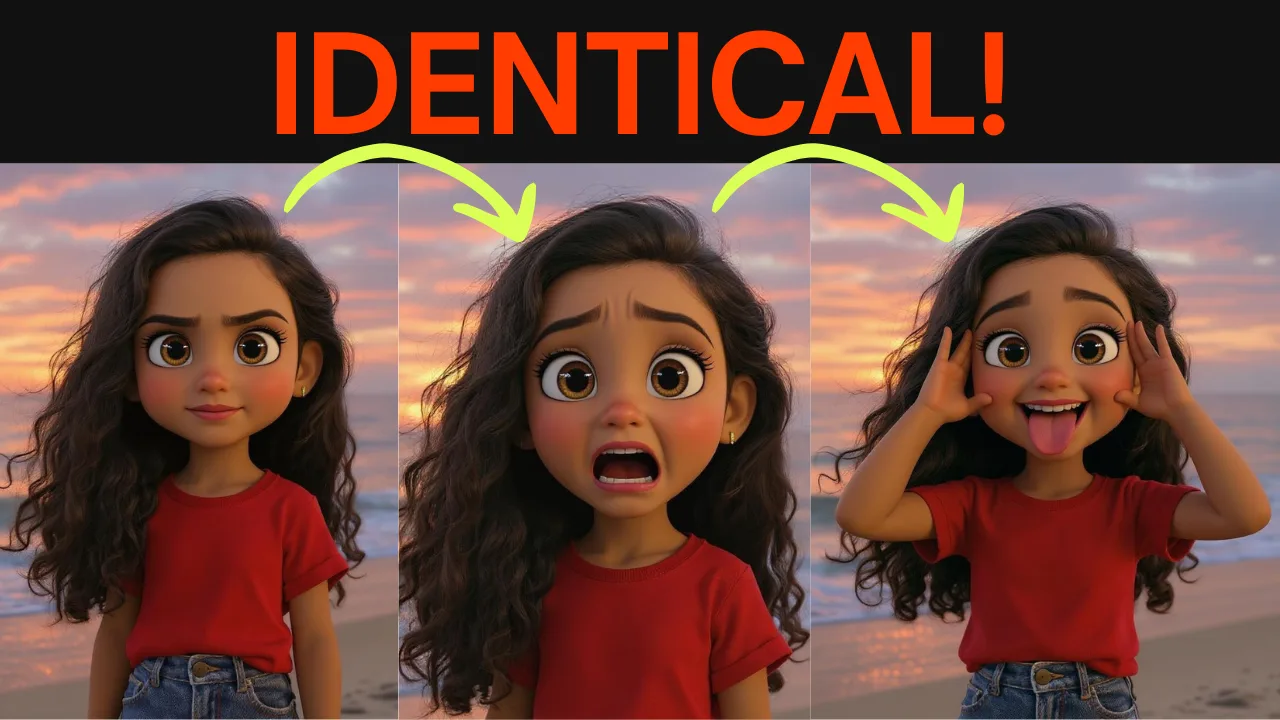
Expression Editor moves the eyes, brows, and mouth. Same child, twelve different feelings.

4

Compose it

Drop the character onto a background, or compose up to three with Story Scene Pro. No identity blending.

The same cartoon girl in three expressions, the face unchanged

Why it holds where breadth drifts

Dzine's character feature is real, and it's stronger than people give it credit for. But it lives inside a general studio, so identity is one variable among many you steer with prompts. Neolemon conditions every image on your one anchor and changes a single variable at a time. The face you signed off on page 1 is the face on page 32.

The same approach powers the developer model on Segmind: a character reference plus an optional pose reference. It's a workflow for controlling consistency, not a prompt-and-pray.

The part nobody decodes

In Dzine, a credit is not an image.

This is the single most common complaint in Dzine's reviews, and it isn't a smear. It's how the pricing works. A credit is a wallet, and every tool and model spends it at a different rate.

One action in Dzine Credits it spends What that does to a plan
Character image, Fast mode4 creditsThe cheap, stretchy case
Character image, Normal mode8 creditsDoubles your burn quietly
Training one character30 creditsBefore a single usable scene
GPT Image edit in chat35 creditsOne edit, nine Fast images gone
Nano Banana Pro at 4K40 creditsEasy to trigger by accident
A 5-second Veo 3.1 clip400 creditsA month of video budget, fast

Dzine, for a power user

Flexibility

If you know the system, those rates are a feature. You route the cheap models for volume and spend big only when it counts.

Dzine, on a deadline

Planning anxiety

For an author trying to answer "what will my book cost?", the answer is "it depends which mode you were in," which is the wrong answer to be guessing.

Neolemon

One rate, full stop

Character Turbo is 4 credits an image. That's the math. 600 credits is about 150 generations a month, and there's no wrong mode to fall into.

None of this makes Dzine a bad deal. It makes Dzine a deal you have to understand. A simpler envelope is its own kind of feature when your goal is to finish one thing.

Feature by feature

The full comparison.

Grouped by what you're actually deciding on, and grounded in both products' own pages. Where Dzine is the stronger pick, it says so plainly.

Capability Dzine AI Neolemon
Character control
Consistent-character workflowYes, one feature in a broad suiteThe whole product: anchor plus editors
Pose and actionPreset actions in the character toolDedicated Action Editor
ExpressionSteered by promptDedicated Expression Editor
Outfit and camera angleInsert and edit toolsOutfit and Perspective Editors
Character training and storageUp to 30 photos, 10 to 120 saved slotsSingle-reference anchor, reused anywhere
Multi-character scenesMulti-character edit and lip syncMulti Character and Story Scene Pro, 1 to 3
Breadth and media
AI videoYes, Veo, Sora, Kling, WanNo, frames only, animate downstream
Lip sync and talking avatarsYes, single and multi-characterNo
Face swap, try-on, image-to-3DYesNo
Model varietyMany image and video modelsCartoon-tuned models, fewer knobs
Photoreal humans and productYesNo, cartoon-only since 2025
Book and story production
Photo to cartoon characterVia style transferDedicated Photo to Cartoon tool
Coloring-book pagesVia general image toolsColoring Book Creator, one click
Storyboard and book layoutGeneral canvas and editorProjects, Storyboard View, PDF export
Developer APINot the core productSegmind V3 API
Pricing, trial, and rights
Free way to try7-day trial, free outputs are public20 credits, no card, private
Lowest paid tier$8.99/mo Beginner$29/mo Creator, 600 credits
Credit mathVaries by tool, mode, and model4 credits per image, one rate
Commercial rightsPaid plans, free tier is personal onlyEvery paid plan
Public review sentiment3.4, 55% 5-star, 40% 1-star4.5, 94% 5-star

Pricing and credit costs as listed on Dzine's own public pages, which don't always agree with each other. Review counts are small on both sides. Check Dzine's live pages before you buy.

Pricing

Cheaper to enter. Harder to predict.

Dzine's entry price genuinely beats ours, and its free credits look generous. The catch isn't the sticker, it's everything around it.

Dzine AI

PlanPriceThe shape
Beginner$8.99/moImage tools only
Creator$24.99/moImage and video credits
Master$59.99/mo"Unlimited" image, fair-use
Master Pro$149.99/moLarge video buckets
  • A credit is not one image. Tools and models burn different amounts.
  • "Unlimited" is bounded by a fair-use policy, with no bots or bulk generation.
  • Subscriptions auto-renew, and renewal payments are non-refundable.
  • Once you cancel, unused credits do not roll over after the billing period.
  • Free-tier outputs are personal-use only and may appear in the community feed.

Neolemon

$29 / month, flat

600 credits, about 150 generations. Plus a free trial: 20 credits, no card.

  • One credit type. 4 credits per Character Turbo image, every time.
  • Prompt Easy, Randomize, Translate, Speech, and AI Improve cost nothing.
  • Every character-consistency editor included on the one paid plan.
  • Commercial-use rights included. Your free-trial work stays private.
See Neolemon pricing

Dzine is genuinely cheaper to start, and a strong deal for a high-volume creator who works across many media. Neolemon wins the moment your question becomes "what does this one book cost?", because the answer never moves.

The math on a real project

A 24-page picture book, costed both ways.

A polished short picture book needs roughly 100 generations once you count the retries. Here's how that lands on each plan, honestly.

What the book needs Generations Dzine, Fast mode Neolemon
Lock the main character~1040 credits40 credits
24 page scenes plus retries~60240 credits240 credits
Multi-character scenes~2080 to 160 credits80 credits
Cover and back cover~1040 credits40 credits
Roughly~100~400 of 3,000~400 of 600

On the raw numbers Dzine has more headroom, and for a disciplined user it's real. The catch is mode discipline: one stray GPT Image edit, one 4K render, one Veo clip, and the headroom collapses. Neolemon's tighter envelope is also a tighter mental model, which for a deadline is worth something.

Proof, with names

What people actually ship and say.

Both sides, real names, the good and the brutal. Small samples on both, so read them as texture, not a verdict.

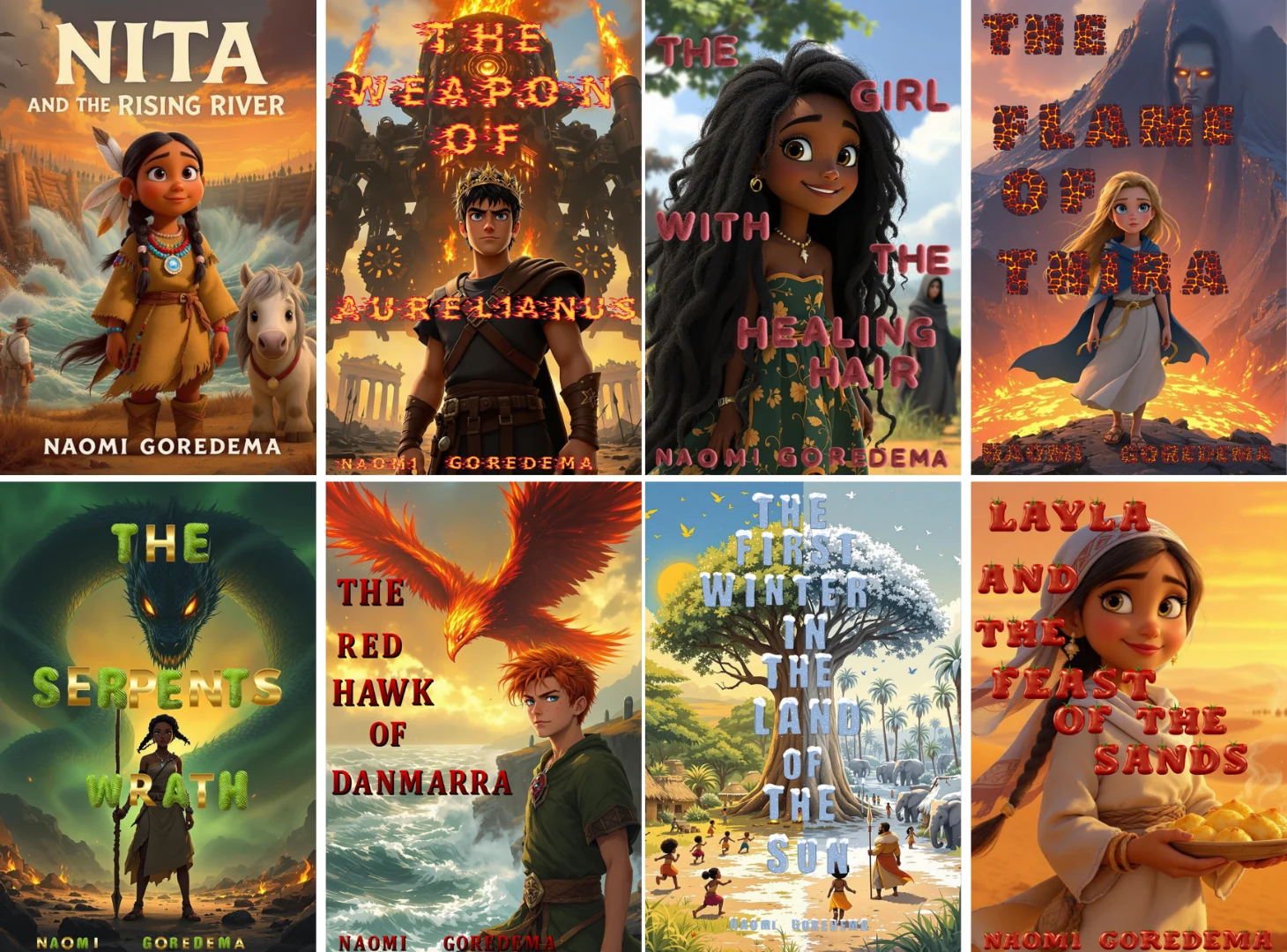
Finished children's book covers illustrated with Neolemon by author Naomi Goredema
20 books in 4 months. Naomi Goredema, children's author. Her old workflow with InDesign, Photoshop, and Midjourney took about three days per character.

On Dzine AI

Dzine's Trustpilot is polarized: 3.4, with 55% 5-star and 40% 1-star. The praise is real, and so are the complaints.

"An essential hub. Persistent characters, styles, big-name image models, lip sync, and playgrounds for creating consistently."

Maude, on Trustpilot

"AI-powered Photoshop. I cancelled three other platforms after adopting it." (Also notes it's "overwhelming at first.")

Jose Romero, on Trustpilot

"Before you learn it you throw away a lot of credits and money."

Ruben Isonline, on Trustpilot

The complaints cluster on three things: credit burn while learning, billing friction around renewals, and failed video jobs that still cost credits. They map to Dzine's own policies, not to misunderstanding.

On Neolemon

Our proof is finished work, not tool reviews.

  • Patricia Wonsey, a former teacher, made over $1,000 in her first week selling coloring books built on Neolemon.
  • Brian McPhee shipped an 83-page book with 47 illustrations, 13 characters, and 12 stories.
  • Erica Weinstein built an 8-scene rom-com storyboard with the same cast across every scene.
  • "This app has become an invaluable tool in my creative process." Joanne Mohammed, children's author.
4.5★★★★★34 reviews, 94% 5-star on Trustpilot

Credit where it's due

Where Dzine AI wins.

We'll go first. These are things Dzine does better than us. If one of them is what your project needs, it's the right tool, and we'd tell you to use it.

A real all-in-one studio

Image, editing, video, lip sync, face swap, try-on, and 3D under one subscription. We don't try to be this.

Video and lip sync

Veo, Sora, Kling, Wan, and multi-character lip sync. If your characters need to talk or move, this is the clear call.

Model variety

Nano Banana Pro, Midjourney, GPT Image, Flux, and more, useful while you're still hunting for the look.

Photoreal and product

Realistic humans, headshots, product photography, virtual try-on. We dropped photoreal in 2025.

Canvas and layers

A drag-and-drop editor with layers and background removal, a real edge over prompt-only tools.

Lower entry price

$8.99 a month gets you in the door. Our cheapest paid plan is $29. On sticker alone, Dzine wins.

Trained-character slots

Train from up to 30 photos and store many characters, strong for managing a roster of mascots or clients.

A credible, funded team

Founders out of Adobe Research and Tencent AI Lab, with a fresh Series A. This is a serious product.

Take Dzine seriously and build something good with it. If you later hit the wall most story creators hit, on consistency or credit math, you know where we are.

Our turn, same rules

Where Neolemon wins.

Narrow on purpose. Built around the one failure mode that breaks every general studio: the same character, page after page.

Consistency is the product

Not a feature bolted onto a design suite. The entire tool exists to hold one character steady across a story.

Editors, not fresh prompts

Change pose, expression, outfit, or angle one at a time. Identity stays locked instead of re-rolled.

A book-shaped workflow

Story Scene Pro, Projects, Storyboard View, and PDF export map to the steps of making a book, not editing an image.

Predictable credit math

4 credits per image, one rate, no mode to get wrong. You can actually budget a project.

Coloring books for KDP

Any image becomes a print-ready coloring page in one click, a high-volume self-publishing category.

A no-card private trial

20 free credits, no card, and your unpublished character never lands in a public community feed.

Cartoon specialization

We dropped photoreal in 2025 to go deep on cartoon storytelling. The focus shows in the output.

An education layer

A course, a free community, a 35,000-subscriber newsletter, and the Consistent Character GPT with a million-plus uses.

Founder-led support

Two founders who answer support themselves. The kind of thing churned Dzine reviewers say they missed.

Route yourself

Who should pick which.

Dzine AI

  • You want one workspace for images, video, lip sync, avatars, and general design editing.
  • You switch between many models and like to experiment with the look.
  • You need short-form video, animated promos, or lip-synced clips alongside stills.
  • You need photoreal people, product shots, virtual try-on, or image-to-3D.
  • You run an agency or shop and want a horizontal creative suite at a low entry price.

Neolemon

  • You're illustrating a children's book and need the same hero on every page.
  • You publish to Amazon KDP, storybooks or coloring books, and want a workflow built for it.
  • You want a guided path instead of a maze of models and modes.
  • You're a teacher or comic creator building around a recurring character.
  • You want simple credit math, commercial rights on the cheapest plan, or the Segmind API.
  • You'd rather try without putting a card down.

Use both

  • Neolemon for the book interior, Dzine for the launch trailer with a talking character.
  • Dzine for photoreal product visuals, Neolemon for the brand mascot.
  • This isn't a religious war. Pick the one whose center of gravity is closest to your project.

The switch

Moving a project from Dzine to Neolemon.

Decided to try Neolemon for one specific book? Here's the cleanest path over, without losing the character you already built.

  1. 1

    Pick one project

    Don't migrate everything. Choose one book, comic, or series. Keep Dzine for the broad work.

  2. 2

    Export your character

    Download the best full-body front view of your hero at the highest resolution you have.

  3. 3

    Start the free trial

    20 credits, no card. About five Character Turbo generations to test the fit.

  4. 4

    Cartoonize if needed

    If your Dzine output isn't cartoon, run it through Photo to Cartoon first. If it is, skip ahead.

  5. 5

    Generate the anchor

    Use free Prompt Easy to structure the description, then lock the canonical anchor in Character Turbo.

  6. 6

    Build with editors

    The mindset shift from Dzine: don't write a fresh prompt per scene. Pose, emote, and redress the anchor.

  7. 7

    Handle multi-character

    Two characters with Multi Character, up to three in Story Scene Pro. Past three, expect to iterate.

  8. 8

    Sequence in Storyboard

    One project per book. Drag scenes into panels, write the narration, export the storyboard PDF.

  9. 9

    Finish for print

    The storyboard PDF is for review, not a print interior. Set trim, bleed, and 300 DPI in your layout tool.

  10. 10

    Time your cancellation

    If you're switching fully, cancel Dzine before renewal. Credits don't roll over once you cancel.

No half-truths

What to watch out for, on both sides.

Dzine AI

  • Credit costs vary by tool, mode, and model. A new user can burn money learning.
  • Its own pages disagree on Beginner credits and daily free credits. Check at checkout.
  • "Unlimited" plans are bounded by a fair-use policy that can throttle speed or model access.
  • Subscriptions auto-renew, renewal payments are non-refundable, and credits don't roll over after cancellation.
  • Failed or stuck video jobs still cost credits, a recurring complaint in reviews.
  • Free-tier outputs are personal-use only and may appear in the public community feed.

Neolemon

  • Cartoon-only since 2025. For photoreal humans, Midjourney or Flux is the right tool.
  • No video or lip sync. We make consistent frames, then you animate downstream.
  • Three or more characters in one frame still need iteration, and fine details can vary.
  • Multi Character V2 is square-only. Use Reframe for portrait page layouts.
  • The storyboard PDF is a storyboard, not a print-ready KDP interior. Verify print specs separately.
  • Commercial-use rights aren't copyright ownership, and KDP requires AI disclosure either way.

We'd rather lose a buyer to honesty than win one with a half-truth.

Questions

What buyers ask before switching.

What's the best Dzine AI alternative for consistent characters?+

If your problem is keeping one cartoon character recognizable across many pages, scenes, and expressions, Neolemon is built for that exact job. Its Action, Expression, Outfit, and Perspective editors give you scene-by-scene control by changing one variable at a time. Dzine can create consistent characters too, but inside a much broader studio where holding the character steady is more of your job to manage.

Can Dzine AI create consistent characters?+

Yes, and we won't pretend otherwise. Dzine lets you create a character from text or images, train it on up to 30 reference photos, store it, generate scenes with preset actions, and build character reference sheets. The question isn't capability. It's whether you want that as one feature in a broad suite, or as the center of a focused workflow.

Is Neolemon cheaper than Dzine AI?+

Not on sticker price. Dzine's Beginner plan starts at $8.99 a month; our Creator plan is $29. Neolemon's economics are simpler, one credit type at 4 credits per image, but Dzine has the lower entry price and more daily free credits. The honest comparison isn't "cheaper," it's which one fits your project's cost shape, and a single book is much easier to budget on Neolemon.

Which is better for children's books?+

For building a consistent main character across 24 to 32 storybook pages, with multi-character scenes and a storyboard layout, Neolemon is the more focused fit. Story Scene Pro, Storyboard View, PDF export, and the Coloring Book Creator are all built around children's-book and KDP output. One author, Naomi Goredema, illustrated 20 books in four months this way.

Which is better for AI video or lip sync?+

Dzine, clearly. Neolemon generates consistent frames; motion happens in downstream tools like Higgsfield, Runway, Kling, or CapCut. Dzine has native lip sync, AI video models, and talking avatars. If video is core to your project, Dzine is the right call.

Can Neolemon create photorealistic characters?+

No. We deprecated photorealistic styles in 2025 to focus entirely on cartoon and illustrated work. For photoreal humans, product visuals, or headshots, use Dzine, Midjourney, or another general model.

What happens to my unused Dzine credits if I cancel?+

Per Dzine's own pricing page, cancellation doesn't refund prior payments, and remaining credits do not roll over after the current billing period ends. All subscription payments are non-refundable, and switching plans charges the new plan in full and resets the cycle. Plan your cancellation timing if you're moving fully to Neolemon.

Does Neolemon export a print-ready KDP interior?+

No. Neolemon's PDF export is a storyboard for review and collaboration, not a print-ready interior. For KDP, set trim, bleed of 0.125 inches past trim, and a 300 DPI minimum in your layout tool, and flatten transparent layers before you submit.

Can Neolemon do multiple characters in one scene?+

Yes, with caveats. Multi Character composes two characters; Story Scene Pro composes one to three plus a background reference. Three or more in one frame still pushes current AI limits, and fine details like finger positioning can vary across generations, so iteration is expected for busy scenes.

Can I use AI-generated characters commercially?+

Both Neolemon and Dzine include commercial-use rights on paid plans. Dzine's free-tier outputs are personal-use only and may appear in its community feed. Commercial use is not the same as copyright ownership, which has evolving precedent, and Amazon KDP requires AI disclosure on submitted books.

Does Neolemon have an API?+

Yes. The V3 model is available through the Segmind API for developers and agencies: a character reference plus an optional pose reference. Dzine is a studio product, not an API-first one, so for programmatic character generation Neolemon is the more direct route.

Who's behind each tool?+

Dzine is operated by Seekoo LLC, founded 2023, with founders out of Adobe Research, Tencent AI Lab, and ByteDance, and a Series A reported in 2026. Neolemon is bootstrapped by two founders in Faro, Portugal, Sachin Kamath and Diana Zdybel, and its Consistent Character GPT has crossed a million uses.

The whole comparison, in one question.

When the project's done, what was the hard part? If you needed many media types in one place, you wanted Dzine, and it's one of the strongest studios on the market. If the hard part was keeping one cartoon character on-model across every scene, you wanted Neolemon.

See if your hero holds up across 32 pages.

Run one character through the editors and watch the face stay put. 20 free credits, no card.

If Dzine is the right tool for your project, use it. If consistency across a story is what you're after, that's what we built.